> For the complete documentation index, see [llms.txt](https://guide.maps.gov.sg/llms.txt). Markdown versions of documentation pages are available by appending `.md` to page URLs; this page is available as [Markdown](https://guide.maps.gov.sg/creating-your-map/setting-up-your-csv-file.md).
# Setting up your CSV file
## How does the CSV file work?
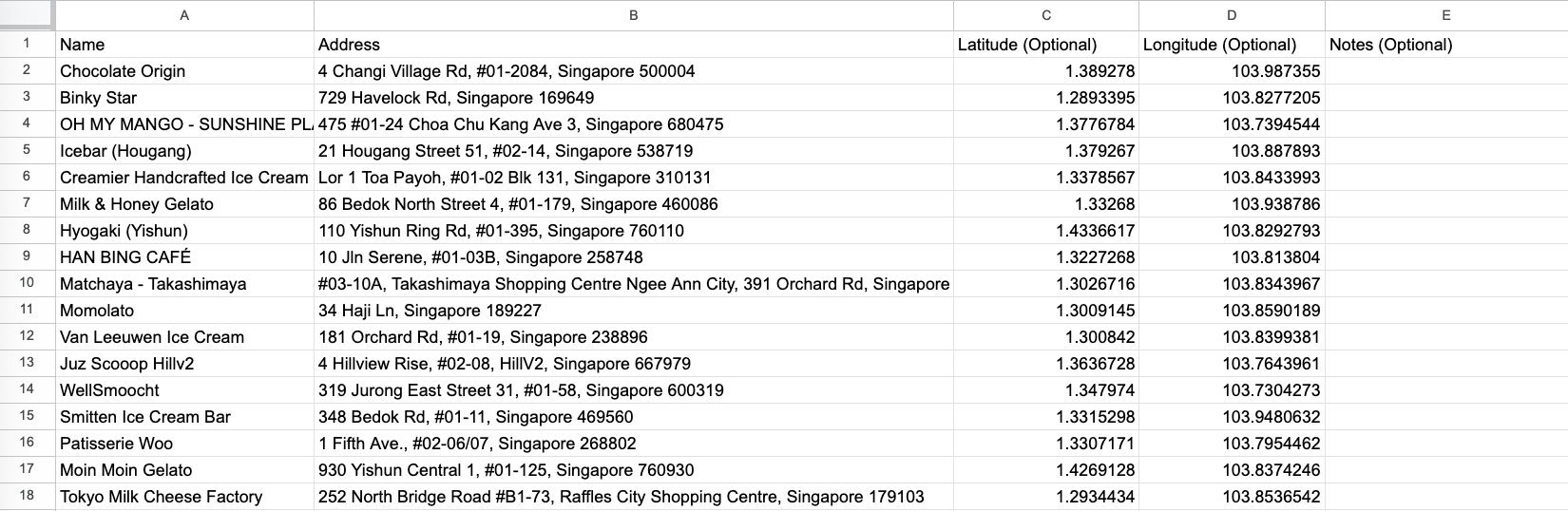
Updating your CSV file allows you to bulk update all locations onto Maps. **Each row represents one location on the map.**
{% hint style="info" %}
Please download the sample CSV file and make edits directly to that file.
{% endhint %}
## Adding addresses
Fill in the address of the location. If the location has a postal code, please include it in the address. Otherwise, you will need to provide the latitude and longitude coordinates instead.
Should both postal codes and coordinates be provided, Maps will use the coordinates to plot the location.
{% hint style="warning" %}
Every location needs either a postal code in its address or both latitude and longitude coordinates. If any row has neither, Maps rejects the whole CSV file and flags the row with the error `Add either a 6 digit postal code in the address column or fill in both latitude and longitude columns`. Fix the row and upload the file again.
{% endhint %}
| Column | Description | Example |
| -------------------- | ----------------------------------------------------------------------------- | ----------------------------------------------- |
| Name | Name of location | Chocolate Origin |
| Address | Address, including postal code of the location. | 4 Changi Village Rd, #01-2094, Singapore 500004 |
| Latitude (Optional) | An optional latitude value for the location if postal code is not available. | 1.389273 |
| Longitude (Optional) | An optional longitude value for the location if postal code is not available. | 103.987414 |
{% hint style="warning" %}
Please note that Google Sheets or Microsoft Excel might automatically remove leading zeros from postal codes. Before uploading your file to Maps, ensure all postal codes contain the correct six digits, or Maps may not be able to pick up your data.
{% endhint %}
## What it looks like on Maps
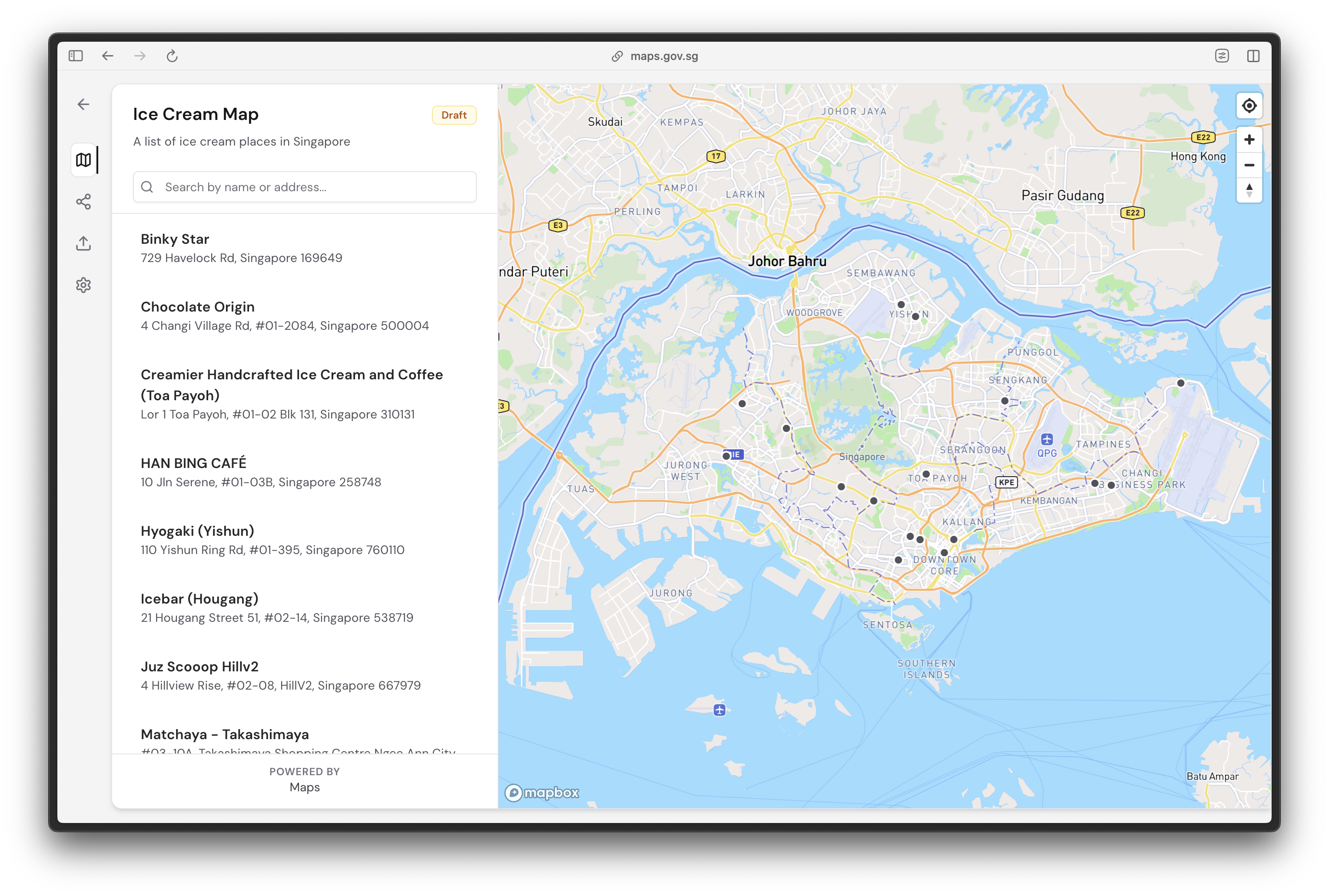
After setting up your CSV file, upload it to Maps and preview your locations mapped out accordingly in draft mode.
## What else can you add to your map?
Other than addresses and latitude and longitude coordinates, you may also add notes, links and filters to your map.
{% content-ref url="/pages/brZA36THWixludVl3JCU" %}
[Adding notes and links](/creating-your-map/setting-up-your-csv-file/adding-notes-and-links.md)
{% endcontent-ref %}
{% content-ref url="/pages/JLBilMA53Mf3GU48B5a0" %}
[Adding filters](/creating-your-map/setting-up-your-csv-file/adding-filters.md)
{% endcontent-ref %}